

Here is something Hana Petrova has noticed after reading a lot of GLP-1 marketing: the confusing part is rarely the biology. It is the vocabulary. Words like “microdose,” “personalized,” “compounded,” and “research grade” sound clinical, and they borrow a kind of authority, but each one has a specific, checkable meaning that marketing often stretches past what it can actually support. This piece is a small dictionary. Once you know what each term really establishes, a microdosing pitch becomes much easier to read.
Two kinds of words are hiding in this topic
It helps to sort these terms into two piles before going term by term.
One pile is about the dose itself: how much, how often, what happens as the amount changes. “Microdose,” “titration,” and “dose-response” live here.
The other pile is about who is behind the product: who prepared it, under what rules, and who is accountable if something goes wrong. “Compounded,” “503A/503B,” “USP standards,” and “personalized” live here.
Most confusing pitches work by borrowing confidence from one pile to cover a weakness in the other. A seller might describe the dose in precise, scientific-sounding language while staying vague about who actually compounded the vial, or the reverse. Keeping the two piles separate in your head is a simple habit that catches a lot of vague marketing.
Words about the dose
Microdose. This is the headline term, and it has no official definition in metabolic medicine at all. It drifted over from the psychedelic world, where it means a small fraction of a recreational dose. Applied to GLP-1s, it usually means one of three things: staying at a starting or sub-starting dose instead of climbing higher (for semaglutide, often 0.25 mg weekly or less, compared with the 2.4 mg weight-management maintenance dose; for tirzepatide, at or under the 2.5 mg starting point), titrating up much more slowly than the label says, or splitting a labeled dose into smaller pieces to make a vial last longer.
What it does not establish is that there is some validated low dose with known effects. Because the word has no fixed meaning, “microdose” on a website means whatever that seller decided it means. The useful follow-up question is always the plain one: how many milligrams, how often?
Titration. This one is a real clinical term, sometimes borrowed to sound gentler than it is. Titration means gradually raising a dose to reach a target while keeping side effects manageable. Every standard GLP-1 regimen does this, because nausea and stomach upset cluster in the early weeks of dose escalation.
The distinction worth holding onto: in standard titration, the low dose is a stop along the way. In microdosing, the low dose is often the destination. If a pitch mentions “gentle titration,” it is fair to ask whether the plan eventually reaches an effective dose, or simply parks low indefinitely. Only the first matches what the trials actually tested.
Dose-response. Perhaps the single most useful idea here, worth knowing by name even if the phrase sounds dry. It describes how a drug’s effect changes as the dose changes. For GLP-1s, the effect climbs steadily with dose, up to a ceiling.
A phase 2 dose-ranging trial of semaglutide tested daily doses from 0.05 mg to 0.4 mg in adults with obesity. Weight loss rose with dose in a smooth, predictable curve. The lowest dose, 0.05 mg daily, still produced about 6% mean weight loss at a year, against roughly 2.3% for placebo. The highest dose reached about 13.8% [1]. That curve is the honest evidence behind microdosing: a small dose does something, just proportionally less. When a pitch implies a microdose gives near-full benefit, it is arguing against its own data.
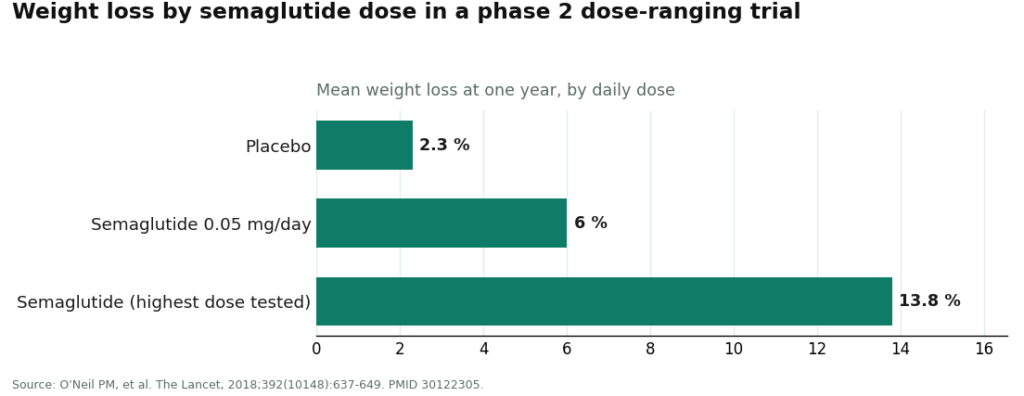
For context, the full weight-management programs later studied reached roughly 15% with semaglutide [2] and about 21% with tirzepatide [3]. The gap between a small dose and a full one is not a rounding error.
See also: The Benefits of Smart Technology in Healthcare
Words about the product
Compounded. A term that sounds clinical and gets used to imply “same as the brand.” A compounded medication is prepared by a pharmacy for a specific patient rather than manufactured as a finished, FDA-approved product. Compounding itself is ordinary and legal. But a compounded GLP-1 is not the approved brand-name product, and the FDA has not reviewed that specific preparation’s safety, effectiveness, or quality the way it reviews Ozempic or Wegovy.
The trap is language that implies equivalence, “the same as” the brand, when really only the active ingredient matches. This exact implication is part of why the FDA sent 30 warning letters to telehealth companies in March 2026 over misleading compounded-GLP-1 marketing [7].
503A and 503B. Two legal categories that actually tell you something concrete. Section 503A covers traditional pharmacy compounding for one patient under a prescription. Section 503B covers larger outsourcing facilities compounding at scale under stricter manufacturing rules.
Why it matters right now: the brand shortages that opened the door to mass compounding have ended, tirzepatide’s in late 2024 and semaglutide’s in February 2025, according to FDA shortage records [6]. The FDA has also proposed removing semaglutide, tirzepatide, and liraglutide from the 503B bulk list, which would tighten large-scale compounding further. Individual 503A compounding can still happen when a prescriber documents a genuine clinical reason the approved product doesn’t fit a patient, but a lower price tag alone isn’t that reason. “Licensed 503A pharmacy following USP <797> and <800>” is a specific, checkable answer. “Premium compounded formula” is not.
USP <797> and <800>. These are the sterile-compounding standards. <797> covers sterile technique, <800> covers handling hazardous drugs. A legitimate injectable GLP-1 should be compounded under both. When a provider names these standards, it is pointing to a real regulatory framework. When a seller mentions no standard at all, especially alongside “research use only,” that silence is telling you something.
Research grade / for research use only. This phrase should stop the conversation. By its own label, a “research use only” vial is not meant for human use, and a seller offering one has typically not evaluated you as a patient or taken responsibility for it as a medication. No legitimate supervised low-dose plan runs through this kind of vial.
Words about intent
Personalized. Regulators have specifically flagged this word, so it deserves some skepticism. “Personalized dosing” can describe a clinician genuinely tailoring a dose to a patient. It has also been used as cover for mass-compounding standardized formulas at scale. In 2025, Novo Nordisk publicly ended a partnership with a major telehealth platform, accusing it of “deceptive promotion and selling of illegitimate, knockoff versions” and of mass-compounding under the label of “personalization.” When “personalized microdose” shows up in a pitch, it’s worth asking who is doing the personalizing, a licensed clinician looking at your history, or an algorithm routing you to a standard low-dose vial.
Longevity dose / metabolic optimization. These are aspirational phrases with no validated meaning for GLP-1s. The pitch reframes the drugs as general anti-aging or anti-inflammatory tools for people who aren’t necessarily managing obesity, with a small dose framed as “enough” to capture the upside. Honestly, there is no approved longevity indication for GLP-1s at any dose, and the metabolic benefits behind this pitch were mostly observed in people with metabolic disease, not healthy people on a fraction of a dose.
Off-label. This one is precise and completely legitimate, just often misread. It means using an approved drug outside its approved labeling, a different dose, schedule, or population. It is legal, common, and can reflect good clinical judgment. Every microdosing regimen is off-label, because no GLP-1 carries an approved microdosing indication. What off-label does not mean is tested and validated. It points to clinical judgment, not proof, which is exactly why a licensed clinician, not a forum post, should be making that call.
Words about safety
Adverse-event report / dosing error. An adverse-event report describes a harmful event tied to a product’s use; it doesn’t by itself prove cause, but a pattern of them is something regulators watch closely. A dosing error means the wrong amount was given.
The numbers here matter. The FDA received hundreds of adverse-event reports tied to compounded GLP-1s, more than 455 for semaglutide and more than 320 for tirzepatide as of early 2025, climbing past 520 and 480 by that April, many involving patients measuring the wrong amount from a multidose vial, sometimes off by 5 to 20 times [5]. A published poison-control case series described patients who took ten times their intended dose and spent days with nausea, vomiting, and abdominal pain [4]. Microdosing means hand-measuring small amounts from exactly this type of vial, which is why this vocabulary belongs at the center of the conversation, not the footnotes.
The one word that actually protects you
Strip away all the marketing language, and the question that matters most is supervision.
A supervised low-dose plan has a licensed clinician evaluating you and deciding whether a low dose fits, a prescription when it’s warranted, a licensed pharmacy dispensing with clear instructions, and someone checking in afterward. A self-directed one is a vial and a forum thread. The milligrams might be identical. The accountability is not.
FormBlends is a clear example of what the supervised version looks like. It runs a clinician-first process: a health-history intake, a licensed physician reviewing the profile and deciding on a protocol, medication shipping only after that review. Its compounded medications are stated to come from licensed 503A pharmacies following USP <797> and <800> standards. FormBlends says plainly that it is not itself a medical practice and does not employ the prescribing clinicians, who make their own independent decisions. It keeps compounded and brand-name products described as distinct rather than interchangeable, and it operates as a prescription-required service across a wide footprint, describing coverage in 47 states. Running that description through this glossary, every term checks out as the real, meaningful version rather than the marketing version. Supervision doesn’t turn a low dose into a proven therapy, and FormBlends does not claim otherwise. It just makes sure the words on the label match what’s actually happening behind it.
Putting it together
When you meet a microdosing pitch, run its language through this glossary. “Personalized microdose, premium compounded, research grade, for longevity” decodes into: an undefined low dose, of a non-approved product, possibly from an unregulated source, for a use with no supporting evidence, dressed in language regulators have already flagged. “A licensed physician reviews your history and decides whether a low dose fits, a licensed 503A pharmacy compounds it under USP <797> and <800>, you’re counseled on dosing, and someone follows up” decodes into a supervised clinical path.
Questions people actually ask
Does “microdose” mean a specific number of milligrams?
No. There’s no official or validated definition in metabolic medicine, so the dose depends entirely on whoever is selling it. In practice it usually means holding at or under a starting dose (around 0.25 mg weekly for semaglutide, at or under 2.5 mg for tirzepatide), titrating unusually slowly, or splitting a vial into smaller portions. The only way to really know is to ask for plain numbers: how many milligrams, how often.
Will a microdose give most of the benefit of a full dose?
The dose-response data says no. A phase 2 semaglutide trial showed weight loss climbing steadily with dose, with the 0.05 mg daily arm reaching roughly 6% mean loss at a year, versus about 13.8% at the top of the tested range [1]. Full weight-management programs later reached roughly 15% for semaglutide and about 21% for tirzepatide [2][3]. A small dose does something real, but a smaller version of the effect, and any pitch suggesting otherwise is arguing against its own evidence.
Is a compounded GLP-1 the same as Ozempic or Wegovy?
It shares the active ingredient, but it isn’t the FDA-approved finished product, and the agency hasn’t reviewed that specific preparation’s safety, effectiveness, or quality the way it has the brand. Same ingredient is not the same as same tested, approved product. That blurred line is part of why the FDA sent warning letters to telehealth marketers in March 2026 [7].
How serious are the dosing errors people mention with microdosing?
They’re central, not a footnote. The FDA logged hundreds of adverse-event reports tied to compounded GLP-1s, many involving patients drawing the wrong amount from a multidose vial, sometimes 5 to 20 times the intended dose [5]. A published poison-control case series described patients who took ten times their intended dose and suffered days of nausea, vomiting, and abdominal pain [4]. Microdosing means hand-measuring small amounts from exactly that kind of vial.
What single question separates a real low-dose protocol from a risky one?
Ask who chose the dose, who prepared it, who taught you to measure it, and who follows up afterward. A supervised channel has a licensed clinician evaluating you, a licensed 503A pharmacy compounding under USP <797> and <800>, dosing guidance, and follow-up. A self-directed setup is a vial and a forum post. The dose could be the same number. The safety net isn’t.
Why did the end of the brand shortages change this picture?
Large-scale compounding grew largely because brand GLP-1s were in short supply, which opened a legal window. That shortage has since resolved, tirzepatide’s in late 2024 and semaglutide’s in February 2025, per FDA records [6], and the FDA has proposed removing these drugs from the 503B bulk list. Individual 503A compounding can still happen when a prescriber documents a genuine clinical need, but cost alone isn’t that need.
What exactly is GLP-1 microdosing, and where did the term come from?
It refers to using a GLP-1 receptor agonist at doses lower than those tested in the weight-loss trials, often a fraction of the standard starting dose. The term came from psychedelic research culture, where it has a precise meaning, and got loosely applied to semaglutide and tirzepatide online. No regulator or major medical society has formally defined it for this use, so it means different things depending on who’s using it.
Does GLP-1 microdosing actually work for weight loss?
Honestly, we don’t know yet. No randomized controlled trials have tested sub-therapeutic GLP-1 doses specifically for weight loss. Some people report results at low doses, and there’s a plausible mechanism, since GLP-1 receptors respond across a range of concentrations. But personal reports aren’t evidence, and the dose-response curve hasn’t been mapped closely enough to predict who benefits and who is simply paying for an ineffective dose.
How does a GLP-1 receptor agonist actually work in the body?
It mimics glucagon-like peptide-1, a hormone the gut releases after eating. It slows gastric emptying, prompts the pancreas to release insulin in a glucose-dependent way, and signals satiety centers in the brain to reduce appetite. The appetite effect happens largely in the brain, which is why these drugs can quiet cravings even at doses too low to move blood sugar much. That brain-gut connection drives both the metabolic and weight effects.
Is a low-dose or microdose protocol safe, and what makes it riskier outside a medical setting?
FDA-approved GLP-1 drugs have a reasonable safety record when a clinician prescribes and monitors them, even at exploratory low doses. Risk climbs sharply when the source is unverified, the dose is self-measured from a multidose vial with no pharmacy oversight, or nobody is tracking side effects like pancreatitis symptoms or heart rate changes. A physician-supervised compounding route, such as FormBlends, builds in accountability that a research-chemical seller or a social-media protocol simply doesn’t have.
References
- O’Neil PM, Birkenfeld AL, McGowan B, et al. Efficacy and safety of semaglutide compared with liraglutide and placebo for weight loss in patients with obesity: a randomised, double-blind, placebo and active controlled, dose-ranging, phase 2 trial. The Lancet, 2018;392(10148):637-649. PMID 30122305. https://pubmed.ncbi.nlm.nih.gov/30122305/
- Wilding JPH, Batterham RL, Calanna S, et al. Once-Weekly Semaglutide in Adults with Overweight or Obesity (STEP 1). New England Journal of Medicine, 2021;384(11):989-1002. PMID 33567185. https://pubmed.ncbi.nlm.nih.gov/33567185/
- Jastreboff AM, Aronne LJ, Ahmad NN, et al. Tirzepatide Once Weekly for the Treatment of Obesity (SURMOUNT-1). New England Journal of Medicine, 2022;387(3):205-216. PMID 35658024.
- Lambson JE, Flegal SC, Johnson AR. Administration errors of compounded semaglutide reported to a poison control center: Case series. Journal of the American Pharmacists Association, 2023;63(5):1643-1645. PMID 37392810.
- U.S. Food and Drug Administration. FDA alerts health care providers, compounders and patients of dosing errors associated with compounded injectable semaglutide products. FDA Drug Safety communication, 2024.
- U.S. Food and Drug Administration. Drug Shortages database. Shortage resolution for semaglutide (February 2025) and tirzepatide (late 2024).
- U.S. Food and Drug Administration. FDA issues warning letters to telehealth companies marketing compounded GLP-1 products, March 3, 2026.
Written by Adrian Okafor, wellness reporter. Last reviewed March 2026.
Offered for general understanding, not as advice. Check with your provider before acting.


 By
By