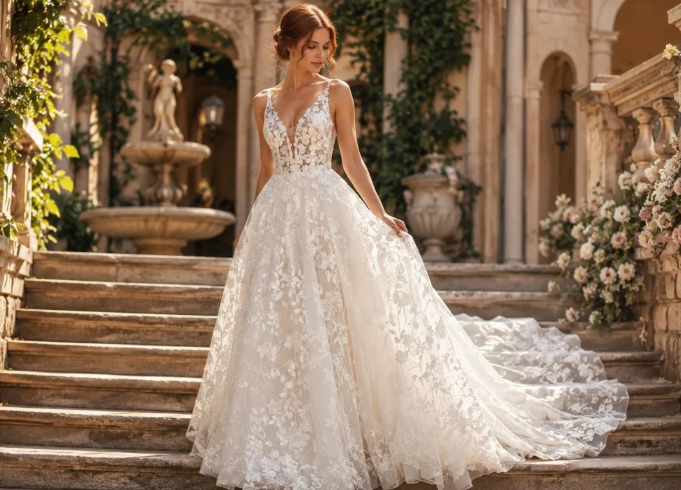

One rule does most of the work here: the veil should echo the dress, not compete with it. If your gown is heavily worked, keep the veil light. If your gown is plain, the veil can carry the detail. Every other decision, which lace, where it sits, what shade, follows from that starting point.
Lace veils scare brides more than any other style because the failure mode is visible: two laces arguing with each other in every photo. The good news is that the pairing rules are simple, and they leave far more room than most brides think.
The echo rule in practice
Matching your veil lace to your dress lace exactly almost never works unless both come from the same maker. Aim for compatible, not identical. That means matching three things:
- Scale. Fine, small motifs on the dress call for fine motifs on the veil. A bold guipure gown next to a delicate eyelash edge looks accidental.
- Mood. Romantic soft florals with romantic soft florals; graphic modern lace with graphic modern lace.
- Density. A dress covered in lace pairs best with a veil that uses lace sparingly, at the edge or scattered, so the eye has somewhere to rest.
If you keep those three consistent, nobody will ever notice the patterns are different.
Know your lace
| Lace type | Look and weight | Pairs best with |
| Chantilly | Fine, flat, lightweight, delicate net ground | Soft, romantic gowns in chiffon or light lace |
| Alencon | Corded outlines that give motifs definition | Satin and structured gowns that can hold their own |
| Guipure | Bold, dense motifs with no net between them | Modern, minimal dresses that want a graphic edge |
| Embroidered tulle | Motifs stitched straight onto the veil, often floral | Almost anything, since density and placement are controllable |
Embroidered tulle deserves a special mention because it behaves differently from traditional edging lace. The motifs can be concentrated at the hem, scattered up the drop, or built into dimensional florals, which makes it the easiest way to get a lace look that cannot clash with the dress, because there is no second lace pattern to clash with.
Plain dress, lace veil: the easiest combination to get right
If your gown is clean crepe, mikado, or satin, you are in the strongest possible position. The dress becomes the backdrop and the veil becomes the event. This pairing also gives you two looks in one day: detailed and dramatic for the ceremony, sleek and modern the moment the veil comes out for the reception.
Scale is the only decision left, and seeing options side by side helps more than any description. Looking through a range of lace wedding veils in one place makes the differences obvious, from a narrow edge that just catches the light to full-coverage florals that read from the back of the room.
Placement changes everything
Where the lace sits matters as much as how much of it there is:
- A full-length lace edge frames the entire silhouette and suits classic, formal weddings.
- Lace concentrated at the hem keeps the area around your face soft and puts the detail where photographs catch it, trailing behind you.
- Scattered motifs that fade toward the comb give a modern, grown-in-the-tulle effect and keep weight off the top of your head.
- If you wear a blusher, keep the front layer light. Heavy lace over the face competes with your makeup in close-ups and adds weight you will feel.
Get the shade right
White, ivory, and champagne read as dramatically different colors in photographs, even when they look close in person. Take a swatch of your dress to any veil appointment, or request one from your dressmaker, and check the pairing in daylight rather than shop lighting. Studios that hand-make their veils, such as Tara Bridal, typically work in a defined shade range, so naming your dress color when you order matters more than it does with mass-produced accessories.
A slight mismatch is not always wrong, for what it is worth. A veil half a shade lighter than the dress can lift the whole look. A veil darker than the dress rarely flatters either.
See also: Understanding Law: The Power Behind Justice and Rights
Quick answers to the questions brides actually ask
Does my veil lace have to match my dress lace? No, and forcing an exact match usually looks worse than a deliberate echo. Match scale, mood, and density instead.
Can I wear a lace veil with a satin dress? Yes. It is the classic pairing for a reason: the smooth surface shows the lace silhouette better than any other fabric.
Can I wear a lace veil with a lace dress? Yes, if the veil uses lace more sparingly than the dress, or if the veil is plain tulle with a modest lace edge. Full lace on full lace only works when the scales match closely.
Is lace too traditional for a modern wedding? Guipure and graphic embroidered styles read as fashion-forward, not vintage. Lace is a spectrum, and the modern end of it is very much current.


 By
By